
What it Means to Walk in Christ | Colossians 2:6–7
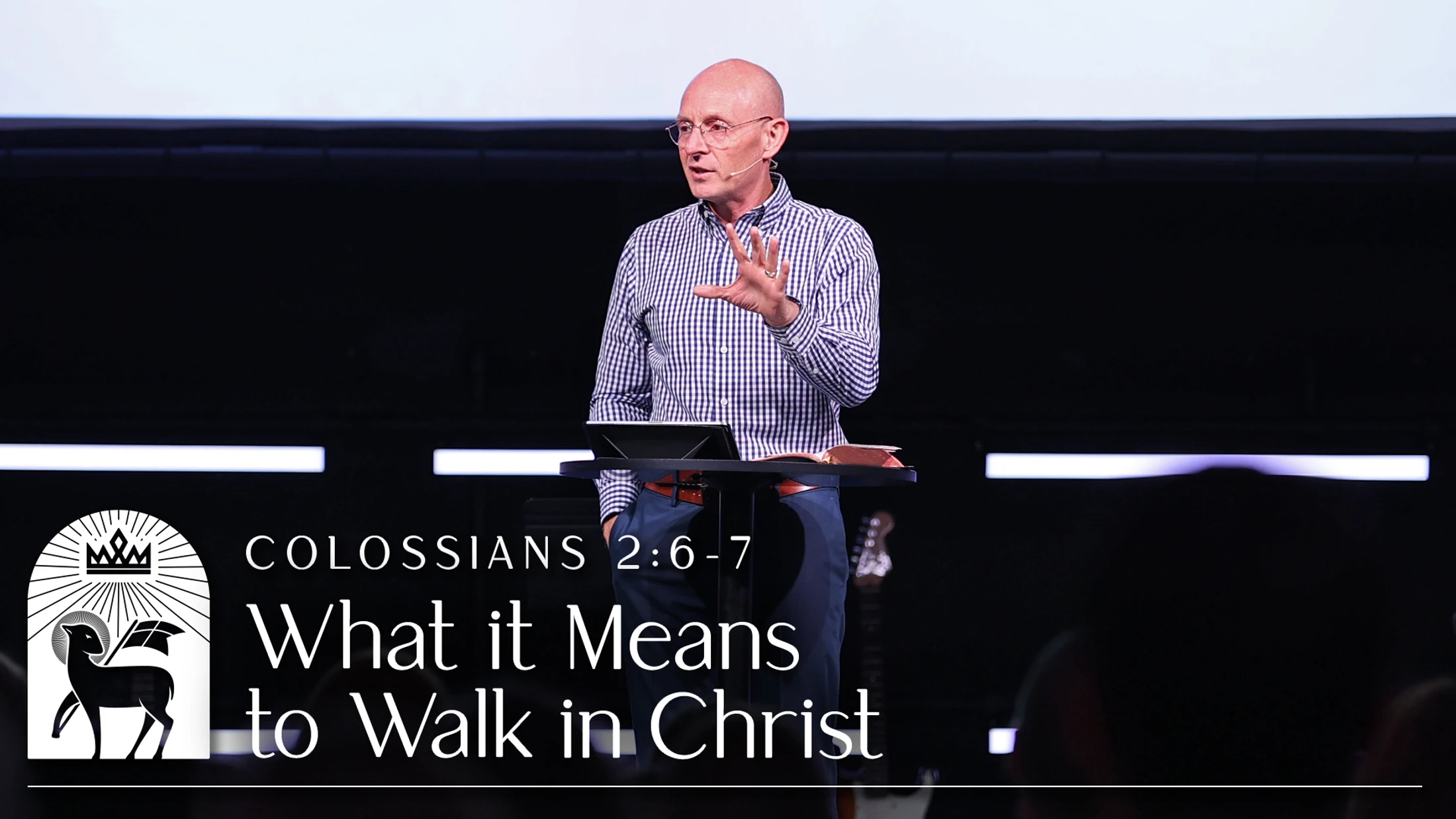
Christ’s preeminence means I will live vertically relational, verifiably doctrinal, faithfully generational, and abundantly thankful. Listen to this practical message on being rooted in Christ from Colossians 2:6–7. Learn more about our Colossians series at firstfamily.church/christ-alone.
What a fantastic song to get us into Colossians chapter 2, verse 6, and that's where we're headed. So go ahead and take your Bibles, both here in this room, our live streaming venue upstairs, our various campuses, Guttenberg and Carlisle. Let's all get under the weight of the Word.
We say this almost every week. I love hearing you say it because we deeply believe it. It's the Word that does the work.
And I think today you'll find that to be true once again. Before we dive into the Word, however, let me just mention a couple of things. One is, I just want to echo the priority of VBS here.
I get to preach in some kind of kid's decor at least once a year. Today I'm preaching in Legoland, so it's kind of a neat moment here, right? But I want to encourage, just pray, serve, give, help, be attentive, and let's continue to really make this part of the summer for our city in which we just keep getting the gospel to those who have yet to hear the great name of Christ. Well, your Bibles are open by now to Colossians chapter 2, right? We're going to dive into the two verses that begin the third section, six and seven of the verses.
Put a finger there. Put an eye on those verses. I think the best way to kind of set a framework for how we're going to explore them and see what they really mean to us is for me to ask you this question.
Think about a moment in your life when the direction of your life changed. In this room, upstairs, or other campuses, think about this. When was there a moment in time that brought about changes over time? Something changed the trajectory of your life from then on? You're probably thinking of a few examples, and there are some that are more negative in the sense that sometimes trials, difficulties do this, but I'm thinking of a couple of positive examples.
I think the one you're thinking of starts with an M, marriage. It just changes you, doesn't it? And shoot, it's a moment in time. I did a wedding yesterday for a friend in our church, and so Ashlyn married Andy, and now the trajectory, the direction of their life has changed.
Before that, they weren't a husband or a wife, but now they're a husband and a wife. So behavior, identity, conduct changes. I think about having kids.
That changes your identity, and I mean that in every good way. You're not a dad or a mom until you have a child. Then when you're a dad or a mom, that stays with you.
It changes your identity, your behavior, your trajectory, your direction. There are times in life when a moment in time changes us for the rest of time, and those changes do happen incrementally. We get better at them.
They're understood and experienced progressively, but nonetheless, things change over time from a moment in time. That's the concept in Colossians 2, 6, and 7, the opening of the third section. Let's go to our lab.
I want to break this down. Mind every jewel we can from these verses, and let's rejoice together in what God will show us. My sense is when we get to the end of these two verses, which is one sentence, I hope your heart is about to explode and burst with the greatness of God weighing in on you, all right? Here it is, Colossians 2, 6, and 7. In fact, will you read this together with me this morning out loud, all of us together? Verse 6, so then, just as you have received Christ Jesus as Lord, continue to walk in Him, being rooted and built up in Him and established in the faith, just as you were taught and overflowing with gratitude.
Now, notice in this sentence, the two main verbs, have received speaks of a point in time, and then continue to walk speaks of something over time. You follow the progression here. Now, the words so then indicate to us that He's looking back at something He has said and that He's looking forward.
So, in light of what I've said, and we'll explain what that is in a minute, I'm now saying this. So, it's kind of a transition word. This does begin the third section.
This third section of Colossians runs through the whole part of chapter 4. It's the longest section, and I personally think that what happens is He's going to explain more about how we walk in Christ in the remaining chapter and a half. He starts by just making this statement, though, that there has been a reception in your past and it should affect the direction of your future. You follow that? Not hard to get.
This is what He's saying. These verbs indicate this to us. The question we should ask ourselves is this, what did they receive that so dramatically changed their direction? Well, the answer is a who, and this is where the verse gets astoundingly delicious.
I'm praying even now that the Holy Spirit will just really press this truth into us, because often we read these verses and we talk about them. We focus on parts that are important, but we really miss the fundamental core that makes all of it possible, and it's who they received because that's what changed their direction. Paul says it is Christ Jesus as Lord.
This is an incredible name. It's the only time in the New Testament that Christ is referred to in this way. It's not the only time these three names are used.
It's the only time these names are in this order. Sometimes you see the Lord Jesus Christ, sometimes you see Jesus Christ or the Lord Jesus or Christ the Lord. In this moment, Paul specifically words it this way, and not only does he word it in this order, I think for a specific reason, he actually adds two definite articles.
I'm going to be a little word geeky with you for a minute. Write this down. It's not real clear here in this English translation, but it's powerful.
What Paul does here, he says this, you have received the Christ Jesus the Lord. Now the CSB here inserts the word as, not bad at all. Their sense is the Christ Jesus as of the Lord.
That works. I probably prefer putting in the definite articles, but sometimes it makes for odd reading. The point is there are two definite articles.
Paul's making a precise, intentional point to say that the person you've received at a point in time is none other than, and here's where the order matters. He says, first of all, it's Christ. Now Christ is the Old Testament name for the anointed one.
That's actually what it means in its literal sense, the anointed one. It's the Messiah. It's the eternal Son of God with the Father, but Christ, the eternal Christ with the Father before the incarnation did not have a body.
So he wasn't known as Jesus before he had a body. If you follow me, just kind of nod. But Paul here is saying that the one that God promised, of which the prophecy spoke about, the one that we've all been waiting on, our rescuer and deliverer and savior, the one promised and predicted for hundreds of years, the Christ, the Messiah, that's Jesus.
The one invisible bodily form that you've seen, Jesus is the Christ. And because you saw him die and be raised from the dead, that Jesus who is the Christ is also the Lord. You follow me? So now is your heart getting stirred? I mean, this is fantastic.
This is the one they received, not just another man, not just a good teacher, not just some really superstar celebrity. They received, when they heard the proclamation of the gospel, they received Jesus, the eternal Christ, who by his resurrection was Lord with full authority and power. And so Paul says here, yes, you have received Christ Jesus, the Lord.
It's a proclamation. It's an announcement. Now I remind you that the word, so then, I mentioned to you, they're transition words.
What has he done prior to chapter 2, verse 6? He has established the very fact that Christ is the centerpiece of God's plan, of the church's ministry. Yes, this Christ who is Jesus, one and the same, the eternal Christ is the visible, physical incarnate, is son of God named Jesus. He's the central, supreme, preeminent figure in God's plan, the church's ministry.
He's Lord. And so he's established that fact and now he says, this is whom you've received. He's so authoritative, supreme, preeminent, he should affect the rest of your life.
He should change the trajectory of your existence. This is a powerful, stunning claim that when you receive Christ Jesus, I'll say it this way to you, you sign up for life change. So my question to you is this, before we go to the rest of the sentence, have you received the long-awaited Christ Jesus who is Lord of all? How do I know, Todd? Here's the primary test given in the New Testament.
Is your life changed? Jesus Christ, the Lord, he changes all people who come to him, admittedly over time, hallelujah, amen? We're all a work in progress, it's incremental, it's progressive, but every seed he plants at some point, according to Matthew 13, bears fruit. He changes us. Our reception of Jesus changes the direction of our life.
We continue in what we received. So my question again, if your life has not been a continuing, progressive, incremental change by Christ, but you still say, no, I received Christ, I would just honestly, pastorally ask you to reevaluate. Because your life picture, if that's the normal, I mean over years, if it's just the normal pattern of your life is, yeah, I say I know Christ, but my life really never changes, it never has changed, you're the exception to the normal biblical pattern.
This is an important point, because all of us need change. Now here's some good news. The deepest change we need, God through Jesus does immediately.
He changes our eternal destination the moment we're saved, amen church? He justifies us, he makes us righteous before God, he adopts us into his family, he guarantees that he'll finish his work, so we know that sanctification will be completed, but it is a progressive act. So all these things are wonderful. They're immediate things that were guaranteed that he promises, that's lived out over time.
And so your deepest needs, the deepest change you need does occur immediately, but then there's those practical changes that your wife hopes you'll make, that your husband hopes you'll make, that your kids hope you'll make. There's these other changes that you want to make, but boy, sometimes they just seem so deeply rooted. That's because they are.
It's called your sin nature. You're deeply, I'm deeply depraved, but God is incredibly powerful. He's Lord of all, including your sin, and your habits, and your patterns, and over time God changes people.
He forgives sin immediately, and he frees us from sin progressively. One day he'll free us from sin totally when he comes again, amen? So you see the sense of this, and I just want to ask you very frankly and bluntly, and I've told you this before, I think this is one of the blind spots of the American church. Many people claim to be a Christian, and they actually aren't, and they're fooling themselves.
They think they can sign a piece of paper, and their life never changes, and that makes them a Christian. That's not anywhere in the Bible. The scriptures speak in a very poignant way over many books as a thread, that when Jesus Christ enters the picture, when you receive him, you experience incremental progressive, but undoubtedly you experience life change.
All things are becoming new because the old is past, 2 Corinthians 5, 17. First John, the entire book's about how love and obedience characterize true people of God, and if those aren't in your life, John says you are not of God. So I'm being pretty strong here because I think pastors who don't lean in here really commit pastoral negligence, and we let people just exist in a world that the Bible never really says exists, that you can just be close, and that counts.
You can be near but not in, and God will just kind of wink at that, that you can enjoy the benefits of a Christian community and never really believe, and somehow that suffices. But none of those are true, church. So I want to ask you, are you just close but not really in? Are you near but you don't really belong? Are you enjoying the benefits of a Christian community, but you've never really committed your life to Christ? If that's you this morning, I want to lovingly but clearly and frankly invite you to receive Christ Jesus, the Lord, and watch Him change your life.
Pornography, alcoholism, bitterness, resentment, name the stronghold, the sin. He is Lord of that, and He will forgive you and free you. He will meet you at a point in time and change your life over time.
That's because He is Christ Jesus, the Lord. If your heart right now is resonating like, I need Jesus, I need the ruler, the Lord in my life, right now in your seat, I would just urge you, ask God to save you through Jesus Christ, and He will. He'll save you in a moment in time, and He'll begin over time to change your life through the power of His Word, the power of His people, the power of His Spirit, and it will take some time, but He'll be with you.
He guarantees to finish His work, and you will then understand what this verse means. You will continue to walk in Him because you have truly received Him. So this is one of those backwards messages where I gave the invitation at the front.
But I trust that as we move on to this verse, this sentence, that no one here will resist the call of God to be saved, to trust and receive Christ, because that's the only way you're going to be able to continue to experience life change, to walk in Him, to really keep a trajectory and a direction that's God-focused, is if you have genuinely received Christ Jesus, the Lord. So I could preach on that for three more hours, but I need to move on. So for these who have received Christ, and they're now going to continue to walk in Him, notice how He describes this walk.
I believe He does it in four ways. I think these four ways serve as umbrellas for the remainder of this section. You could probably take everything specifically addressed in section three and tuck it up under most of these four elements.
We'll see if that happens in the next few weeks as we unpack this book. But notice these four elements, weighs the preeminence of Christ, which is really what He's focused at here, Christ Jesus as Lord. He's preeminent, He's supreme.
He's showing us now His preeminence in our life will affect us in these four ways. This is what it looks like to walk in Christ continually now that we received Him as Christ Jesus the Lord. He says, first of all, we're being rooted and built up, and notice the last two words are in Him.
It's very personal, reminds us of the idea of walking in Him, doesn't it? So He says, first of all, when you're continuing to walk in Him, you are vertically relational. I base this on really the words in Him. He's not saying you're rooted and built up in something else or in an idea or a concept.
You're rooted and built up in Him. That's why you're continuing to walk in Him. It's something very personal.
It's relational. So we say it like this. Continuing to walk means you are vertically relational.
In fact, this is the first part of our Take Home Truth. We're going to kind of build it together. We're going to have a longer version.
That's what the LV stands for there, okay? We're going to build the Take Home Truth long version together. And the first observation is this, that Christ's preeminence means that I'll be vertically relational. The two metaphors in play here, it's a horticultural metaphor.
You're rooted, meaning you're going deep with God. And then the second one is an architectural metaphor. You're built up.
You see Josh over here, he's an architect, and something's going higher. Now, don't stretch this too far. Let's not make this metaphor walk on all fours.
He's simply using examples to say that there should be the continuance and the solidification of a life. It should go deep. It should go high.
Like, it should be a solid structure in every direction. And this is what happens when we're in Christ, and watch this, and relating to Him. It's a personal relationship.
So as you get to know God, which is what Colossians 1 and the first part of 2 talk about, this is what will happen. It's a deepening. It's a strengthening.
It's a heightening. And all areas of our life, we become more solid because of our relationship with Jesus Christ. Let me put this in very plain terms to you, perhaps painful terms.
This is describing the person who says, God matters to me. Not necessarily a rule or a law, even though we can find commands to keep us in bounds, this person says, watch this, God matters to me. So they're watching TV.
They're clicking through channels. They're finding something to stream. Surprisingly, they find something that's not good to watch.
Instead of lingering or justifying or rationalizing, they change the channel. They think things like this, like, that's not pleasing to my Father. This is not the heart of God.
Are you following me now? It's a relationship. They'll know they're going to grieve God's heart and the Holy Spirit to linger and watch whatever show has the soft porn or the hard porn or the, I'm not even sure I can even buy half those titles. They don't linger because, watch this, we could find a command in Scripture and say, can't do that.
And we'd be legit to do that. But their heart first says, this isn't pleasing to God. You see the relational bent first, it's the person that when things get tight in the month, they don't first stop giving to the Lord's purposes so they can keep up their out to eat schedule.
No, they think, you know, God's heart is for the nations. God's purposes matter more than my appetites. So I need to fast, I will, but I'm not going to hinder, I'm not going to give less to what God is doing.
Could you find a verse that would give a rule for that? Sure. But it's the person that says, no, man, God matters. And so just create your scenario where there's tension, where there's temptation.
And if your heart goes to the relationship first, like, man, I care about what God cares about. I care about what my father cares about. That's a good place to be.
That's really the gist behind being rooted and built up in Him. It is about a vertical relationship first, where your life consistently screams, God matters to me. Notice the second thing he mentions, that those who continue to walk in Christ because they've received Him, this trajectory, their direction is one that is established in the faith.
And notice the difference here, it's pretty noticeable, not hard to spot. You might expect to see established in Him because that's been the pattern, hasn't it? We're walking in Him, rooted in Him, built up in Him, but now he says we're established in the, say it with me, church, faith. So it's a different object here.
The word faith here refers to a body of beliefs, that which we hold to, our convictions as set forth by Scripture. I believe specifically he's talking about the body of beliefs about Christ Jesus the Lord. That's what we know have been validated, those things we know that have been verifiably seen and true about Jesus.
The word established here actually means validate, to establish, to confirm, to set. And so I think what he's saying here is this, as you relate vertically to Jesus Christ the Lord in a relationship, understand there are also things about this one that are non-negotiable, that are true, they've been validated, they've been verified. So set your feet on those things.
We call them doctrines. We call them beliefs. And there's a set of them that are non-negotiable.
So learn those, understand those, set your feet on those, cement your life in those, stake your eternity on those. They've been established, validated, verified. I like to say this, someone who's continuing to walk in Christ, their life is verifiably doctrinal.
So in the first point, you're vertically relational, just jot that down. Second point here, as far as what it means for the apprentice of Christ to lean in on us, we're showing that we are verifiably doctrinal. Now there's one other aspect of this phrase that I want to bring to your attention.
I think it's included here, it may not be the primary thought, but Paul may be hinting at this, that as you are rooted and built up, as you are giving indication that you know Jesus Christ the Lord, it will be validated that you are in the faith. Could be that. I think it's more the first one.
Either way, just understand, this is the direction of the one who has received Christ. Doctrines are part of the equation. Now let me just pause here and give a very simple application.
Often people like to split the baby here. They're all relational and there's not much doctrine. We say sometimes those folks are like a mile wide and an inch deep, ever heard that? Then there's those who are saying, well, hey, I'm all doctrine and I'm not relational.
I guess they're a mile deep and an inch wide. Is that what we'd say then? I'd never heard anybody use the opposite, right? Can I tell you what I'm aiming for and what I want you to aim for? I don't think it's an exclusive choice. I think we should be a mile wide and a mile deep.
I want to be rightly relational and rightly doctrinal. I want to have a really large smile and an incredibly strong spine. I want to believe the right things and never budge on them based on God's Word.
In a culture that is abandoning all sense of right and wrong, I want to be the guy in that room with a big smile, willing to take the heat and yet kindly say, hey, if you want to converse about that, I have reasoning to why I believe these things. Historical data, evidentials, pieces of information, would you want to talk about that? It might be different than what you're thinking. And just be an inviting person who won't budge.
I think we can do that. I think God's Spirit will empower us to that. So don't make the mistake of thinking, well, I guess if I'm going to be doctrinal, I got to be like the sour guy who's always into the books and I can't have any friends.
Or if I'm relational, I guess I just got to trust these guys to believe and I'll just believe what they say. No, let's embrace. We can be relational and doctrinal.
We can be. And this is what he's talking about here in these first two areas of walking in Christ and continuing this direction. Notice the third thing.
It's all wrapped up in one word. He says, just as you were taught, it's interesting that he is saying here that their establishment in a system of beliefs, in this body of beliefs and their solidification in this life, like all this thing occurred really because they were taught some things. They were taught not just how to live, but what to believe.
Now that means by necessity, watch me here, that someone ahead of them, we'll use that phrase, taught them what they needed to know to continue. Remember the main point here is this idea of continuing. Continue to walk.
So they were taught something that would lean into that, that you were taught some things that would help you continue. But what's this? If those behind us are to continue, guess what we've got to do? It's not a trick question, teach. We've got to take what we've been given and pass it on.
That's why I say really this third area means that we are willing to be faithfully generational. And we won't think and just live with this little bit of conviction. You won't think that your generation's the greatest or the last.
You realize there's folks coming after you. And they'll do things differently than you. In some areas where we have room for preferences, they're going to be a lot different.
But your job as you age is to make sure that the one coming behind you doesn't budge on the non-negotiables. So teach them these beliefs and the importance of a vertical relationship with Christ. Make sure that gets passed down so that they will continue to walk in what they've received.
And I should say in whom they've received. It's generational. And can I confess to you something? As I get older, and I think every person here my age or older would agree with this, your window of what you like narrows.
I heard that laugh. I'm convicted by it. It just becomes a very small sliver of things that you can kind of tolerate.
I want to encourage you, as that happens, to resist the pull to live only in that slice or within that simple scope. It's a lonely existence to try to have everything your way because that window gets smaller and smaller and smaller. You're going to be more lonely than ever.
I'm speaking here mainly about second, third level issues. I would encourage you instead, as you see the next generation coming up, and they'll get closer and closer as you get older, right, to taking over is what I'm saying, hand the baton off and in areas of preference, let them do it a different way. They may not do it the way you did.
They may not fit into your narrowing window of the way it ought to be done, but they're not abandoning non-negotiables. They're holding tightly to the beliefs in the Bible. So let them have the baton and lead so that they continue just like you continue.
I'd remind you, when you started and did it, it wasn't like the folks who were ahead of you and they were saying the same things about you that you're saying about them now. This weighs on me a lot with our children, our grandchildren, our church. We have to find and continue to find ways to pass the baton effectively and be disciplined to make sure that what we're after is the mission getting accomplished, even if the next generation does it a little differently than us.
We must be faithfully generational. And lastly, notice this fourth one, overflowing with gratitude. He just means here, we are abundantly thankful.
The sense is that you're repeating something. You could even say it's an excessive amount. This is the idea of overflowing.
Perhaps he means that we're doing this with excellence. Either way, whether it's excessive or excellent or repeated, he's saying your life should be a consistent display of thank you. Thank you.
Thank you. It's a matter of rejoicing. And then Paul said in Philippians four, and again, I say rejoice.
So jot this down. The one who understands the preeminence of Christ, that he is Christ Jesus, the Lord is abundantly thankful. So that means when the blessing enters your life, you praise the Lord, you thank the Lord for it.
And when it's a burden, you thank the Lord. I don't think you have to pretend that you're always happy about it. You don't have to mask that you're struggling, but you can still voice gratitude even when you have questions.
I prayed with someone this morning after the close of the 830 service. She said life in the last three weeks has been like a pylon. But I want to thank God now for what he's doing.
I'm not sure what it is, and I'm struggling a bit with my emotion towards it all. But I know he's ruler of it all. I thank God for it.
Can we pray that I'll just understand more as time goes by? That's a great posture. No pretense, and yet there's honesty. I find it very interesting that Paul is very clear throughout his epistles that gratitude is just the real character trait of the growing Christian.
The giving of thanks is just a normal part of their life. And here he echoes that. So here's the long version of the take-home truth.
You see it there in front of you? Can you read it with me? We'll just kind of start at the top, go to the bottom. This is just the text in kind of a list form. This is Colossians 2, 6, and 7. Christ together.
Ready? Christ's preeminence means I will live vertically relational, verifiably doctrinal, faithfully generational, and abundantly thankful. This is what it means to have received Christ Jesus the Lord. He's in charge of your life.
He's preeminent and supreme, and he's going to begin to make some changes that are probably going to be in these general areas. He's going to matter to you. That relationship will be your first and foremost relationship.
You will love him above everyone else. As a result, you'll learn things about him, core beliefs and doctrines that will help you understand him more. You'll pass that on to those coming behind you, and the whole while this is happening, you want to be a rejoicing, thankful person.
So that's the long version of the take-home truth. I did put it into a little bit of a chart. I'll just show this to you briefly.
I wouldn't try to write this down here on the spot. Maybe just have a picture. We'll try to post this.
It's hard to read anyway, but I want to mention this because if you'll look to the far right, there are four words in brackets, okay? These are the four action points that I'll talk about on Tuesday's Extra Point Podcast. I wanted to bring them in the message, but I knew I'd be out of time because the text alone is so powerful just in extrapolating what it means. But there is application to it, and so I bring to you on Tuesday four things that I think you should do daily.
They're summed up in the word read, review, relate, rejoice. Listen Tuesday. Just go to our sermon feed page, the website, maybe a social media platform.
You'll find a link somewhere in there, about 20 minutes of application from basically the sense of reception, continuation, and how to make that happen under the power of the Holy Spirit. It all comes from this text right here. And so a lot of words, a chart, kind of a number of things in our heads.
I think it's good to maybe even make this all now shorter. We've done the long version. How about a short version? Can we do that? A take-home truth, these verses in a short version.
Here it is. And this is where I'm praying the Holy Spirit will just ramp up the way He's leaning into your life. Because really what Colossians 2, 6, and 7 is telling us is this, who He is changes how I live.
And if you've not been experiencing changes in direction, you should question, was there legitimate reception? I want to personally just testify that I'm thankful for the way God changes me. I'm still a work in progress. Like you, I'm under construction.
But can I say to you in humility and to the glory of God, I'm not who I was 20 years ago. In fact, I'll just be this bold with you, you don't have the same pastor you had 20 years ago. You don't.
Some folks say, well, it's changed, or you've changed. And I want to say, oh, you bet I have. You needed it.
You needed your pastor to change. In X amount of years in the future, I won't be then the guy I am now. And I hope I'm not.
And I hope this for you. I hope you're not the person in 20 years you are now. I hope we're changing because of God's Word upon us, God's Spirit in us, God's people around us, that He's using all of those to progressively, incrementally change us over time because of something that happened at a point in time.
We received Christ Jesus the Lord, and it made a massive difference forever. That's this verse. That's the preeminence of Christ in a powerful and practical way.
So listen Tuesday for some simple pointers, but know this, my goal isn't to give you pointers. My aim is to give you Jesus, Jesus who is the long-awaited Christ and who is Lord. The pointers, they're just some ways that we can implement the truths that we know.
There are other ways. Others, if you have other ideas, share them in your small group. That's fantastic.
Here's what we all have in common. It's Christ Jesus the Lord. He is the ruler.
He is the preeminent one, the supreme one. So that's what we offer each other. It's Jesus, Christ the Lord, and if you've received Him, I hope this morning your heart is rejoicing that what is continuing for you is further life change, a closer walk with Jesus, a deeper walk with Him, more understanding about Him.
When you leave this world, the next generation continuing that, deeper thankfulness. This is what God will do as you continue to walk in Him, assuming you have legitimately, most assuredly received Him. So I close with this simple question.
If you haven't received Christ Jesus the Lord, would you right now receive Christ Jesus the Lord for the instantaneous forgiveness of your sins and the progressive freedom from your sin? This is what Jesus does, and if you already have, let's continue to walk in Him, amen? Seeing Him and knowing Him and growing in Him more deeply and watching Him change us more and more as we walk in Him. This is the practically powerful preeminence of Christ on display in the church.